
Ebook Download Tomorrow 3.0: Transaction Costs and the Sharing Economy (Cambridge Studies in Economics, Choice, and Society), by Michael C. Munger
The advantages to consider reviewing the e-books Tomorrow 3.0: Transaction Costs And The Sharing Economy (Cambridge Studies In Economics, Choice, And Society), By Michael C. Munger are involving improve your life top quality. The life top quality will not simply about just how significantly knowledge you will certainly obtain. Also you review the fun or enjoyable books, it will aid you to have enhancing life top quality. Really feeling fun will lead you to do something perfectly. In addition, the publication Tomorrow 3.0: Transaction Costs And The Sharing Economy (Cambridge Studies In Economics, Choice, And Society), By Michael C. Munger will certainly give you the driving lesson to take as a good need to do something. You may not be pointless when reading this book Tomorrow 3.0: Transaction Costs And The Sharing Economy (Cambridge Studies In Economics, Choice, And Society), By Michael C. Munger
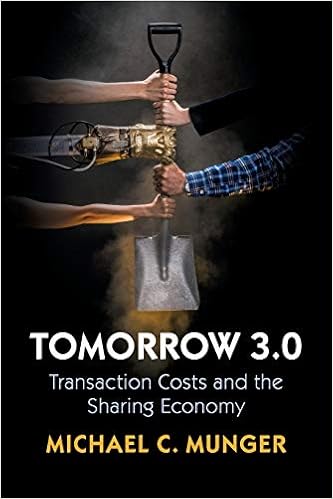
Tomorrow 3.0: Transaction Costs and the Sharing Economy (Cambridge Studies in Economics, Choice, and Society), by Michael C. Munger

Ebook Download Tomorrow 3.0: Transaction Costs and the Sharing Economy (Cambridge Studies in Economics, Choice, and Society), by Michael C. Munger
Thanks for visiting one of the most completed and also updated internet site that bring thousands of book checklists. This is what you could take for obtaining the book as the reference for you in doing the presentation to really feel much better. The book that ends up being referral to read currently is Tomorrow 3.0: Transaction Costs And The Sharing Economy (Cambridge Studies In Economics, Choice, And Society), By Michael C. Munger This is just one of guides that we provide as one part of the wonderful plenty of books from around the world. So, when you find as well as browse the book titles right here, it will certainly be from many nations on the planet. So, it's so completed, right?
With this problem, when you require a publication fast, never ever be worried. Simply locate and visit this site as well as get guide swiftly. Currently, when the Tomorrow 3.0: Transaction Costs And The Sharing Economy (Cambridge Studies In Economics, Choice, And Society), By Michael C. Munger is just what you seek for now, you could get this book directly in this web page. By visiting the link that we offer, you can begin to get this book. It is extremely straightforward, you could not have to go offline and check out the library or book shops.
Are you actually a fan of this Tomorrow 3.0: Transaction Costs And The Sharing Economy (Cambridge Studies In Economics, Choice, And Society), By Michael C. Munger If that's so, why do not you take this book now? Be the very first person which such as and lead this publication Tomorrow 3.0: Transaction Costs And The Sharing Economy (Cambridge Studies In Economics, Choice, And Society), By Michael C. Munger, so you could get the reason and also messages from this publication. Don't bother to be confused where to get it. As the other, we share the connect to check out and download the soft documents ebook Tomorrow 3.0: Transaction Costs And The Sharing Economy (Cambridge Studies In Economics, Choice, And Society), By Michael C. Munger So, you could not bring the printed publication Tomorrow 3.0: Transaction Costs And The Sharing Economy (Cambridge Studies In Economics, Choice, And Society), By Michael C. Munger all over.
Based upon this condition, in order to help you we will certainly show you some ways. You can handle to review the book minimally prior to falling asleep or in your leisure. When you have the moment in the short time or in the holiday, it could help you to complete your holidays. This is exactly what the Tomorrow 3.0: Transaction Costs And The Sharing Economy (Cambridge Studies In Economics, Choice, And Society), By Michael C. Munger will minimally provide to you.
Review
"Timely, insightful, and pitch perfect." From Tweet by Daniel B. Rodriguez, Dean, Northwestern School of Law"Modernity is a never-ending process; people are always looking for ways to make things better. The transaction cost revolution is the next step, and it is already changing lives. With Munger's help and a little Econ 101 knowledge, that change will be much easier to navigate." Ryan Young, Competitive Enterprise Institute. "You should read Munger's new book Tomorrow 3.0... It's not just a book about current events, making sense of Über, and what not. Rather, it's also a theory of property rights. Why do property rights exist? Why do we have an interest in owning things? The answer is 'Transaction costs.' In general, we don't desire to own goods themselves; we desire instead to have ready and immediate access to the services those goods provide. We bother with owning and storing goods because right now, with current technology, there's no easy way to have the services goods provide on demand without owning things. But that's about to change." Jason Brennan, Bleeding Heart Libertarians Blog
Read more
Book Description
Munger brings a fresh perspective on the 'sharing economy' in clear and engaging writing that is accessible to both general and specialist readers. He predicts that smartphones will be used to commodify excess capacity, and reaches the controversial conclusion that a basic income will be required as a consequence of this new 'transaction costs revolution'.
Read more
See all Editorial Reviews
Product details
Series: Cambridge Studies in Economics, Choice, and Society
Paperback: 190 pages
Publisher: Cambridge University Press (March 22, 2018)
Language: English
ISBN-10: 1108447341
ISBN-13: 978-1108447348
Product Dimensions:
6 x 0.4 x 9 inches
Shipping Weight: 9.9 ounces (View shipping rates and policies)
Average Customer Review:
4.2 out of 5 stars
10 customer reviews
Amazon Best Sellers Rank:
#529,875 in Books (See Top 100 in Books)
Things I wish were better: the author states that Amazon loses money on retail (false), and that AWS is just a “generic service robot†and a hosting platform for matching buyers and sellers (false).Later in the book, the author uses revenue and user numbers for Facebook and Twitter from 2015. This is a book published in late 2018! These companies report quarterly and there is no reason not to have used much more recent figures.There are plenty of typos (no spellcheck was run) and a few rudimentary grammar errors.There are some interesting ideas, yes. But as short as the book already is, it could be 1/4 of the length to communicate those ideas (it actually manages to be repetitive).Listening to the podcast on Econtalk with the author is probably all you need.
Full Disclosure: Mike Munger was my advisor at Duke, many (many) moons ago. As someone who lives in Silicon Valley, I think this book provides a clear path to two key ideas:1. How to reduce transaction costs in your company's products/services to get more customers. For example, if you can reduce the distance between your customer and your product, you are likely to have more customers.2. How to think about turning owned goods (like your couch or your TV or the drill you rarely use) into revenue generating assets.Personally, I'm more excited about the latter. The improving opportunities to increase the utilization rate of their owned goods strikes me as a strong way for citizens to (a) make money with what they already have and (b) to reduce production waste.A more environmentally friendly planet would see all goods used at 100% utilization for the duration of goods' lifespans.
Absolute garbage, the author should be ashamed of the monstrosity that came out of his brain. Sharing will never work in the society, neither will paying every single citizen for doing NOTHING.
This gives a great look ahead of how software will connect people with more information to drive down costs.
Many ideas to ponder- well referenced - a worthwhile read. The following is to meet the required word count, blah.
Really enjoyed it. Not too long.
I think the most impressive part of this book is that the author actually made the topic of transaction costs interesting enough to read from start to finish, including the notes. A page-turner, really, just to see what insights were coming next.Transaction costs are probably a whole lot more important than you think, and this book explains why in an engaging way -- striking a perfect balance between respecting its educated audience and staying away from obscure economics jargon. The book wants to persuade, and uses plenty of examples that are easy to relate to -- especially if you ever used Uber. The book pretty much made me say, "Whoa, now I see what is going on when I pay for things. I'm not just buying...stuff; I'm buying the *ability* to obtain better stuff, when I want it, where I want it, and how I want it. And my house is just a storage facility for things I have a use for 1% of the time, and collect dust 99% of the time. This situation needs to somehow be fixed." Read the book for the details.There's a bit of repetition, which is probably a good thing. The package of "triangulation, transfer, and trust" keeps coming back as a reminder of how essential these concepts are to transaction costs. In five years, that might be all I remember from this book -- and if that's true, then it's still more, and far more worthwhile, than what I remember from most other books I've read. Those three words contain a LOT of important information.My only quibble is that I don't care much for predictions. Maybe futuristic-sounding titles sell better, I don't know. I mean, yes, there's an argument that technology will increase the size of the "sharing economy", but there are opposite forces happening. For example, as people get richer, they might be less inclined to want to share -- or even touch -- things that others have used. For example, as people get more affluent, I think they might be pulled towards owning their own clothing instead of receiving "shared" clothing at Goodwill -- even if most of it is unused most of the time. I don't know where this will all end, but I was persuaded that sharing will increase -- though perhaps not as much as the book suggests.So come for the predictions but stay for the explanations. You really will be much smarter when you're finished.
Tomorrow 3.0: Transaction Costs and the Sharing Economy (Cambridge Studies in Economics, Choice, and Society), by Michael C. Munger PDF
Tomorrow 3.0: Transaction Costs and the Sharing Economy (Cambridge Studies in Economics, Choice, and Society), by Michael C. Munger EPub
Tomorrow 3.0: Transaction Costs and the Sharing Economy (Cambridge Studies in Economics, Choice, and Society), by Michael C. Munger Doc
Tomorrow 3.0: Transaction Costs and the Sharing Economy (Cambridge Studies in Economics, Choice, and Society), by Michael C. Munger iBooks
Tomorrow 3.0: Transaction Costs and the Sharing Economy (Cambridge Studies in Economics, Choice, and Society), by Michael C. Munger rtf
Tomorrow 3.0: Transaction Costs and the Sharing Economy (Cambridge Studies in Economics, Choice, and Society), by Michael C. Munger Mobipocket
Tomorrow 3.0: Transaction Costs and the Sharing Economy (Cambridge Studies in Economics, Choice, and Society), by Michael C. Munger Kindle
Tidak ada komentar:
Write komentar